Mini Doctors and Nurses: What Toys and Games Teach About Medical Professions
By Fiona L. Kenney
Children encounter ideas about healthcare long before they ever enter a hospital, doctor’s office, or nursing school. Through toys, books, games, television programs, and other forms of media, they learn what medical professionals do, what healthcare spaces look like, and who belongs within them. These lessons can shape how children understand illness, treatment, authority, and even their own future careers.
This post is the second in my larger MARF project exploring the relationship between children’s media and healthcare environments. The project examines how media, broadly defined as the objects and materials through which ideas are communicated, introduces children to medical spaces, technologies, and professions. Likewise, it treats toys as cultural objects that encourage children to imagine, imitate, and make sense of the adult world around them.
Historians care about toys because they offer valuable evidence of how societies understood childhood, work, and social roles. The toys that adults design for children reveal what skills, values, and aspirations they considered important. Medical toys are particularly revealing because they sit at the intersection of healthcare, education, and popular culture. They show how children were introduced to hospitals and medical professionals, but also how ideas about gender, authority, and expertise were communicated through play.
In this post, I look at four toys and a board game in the Museum’s collection and consider what they can tell us about medical tools, professional roles, and space.
Learning to Play Doctor
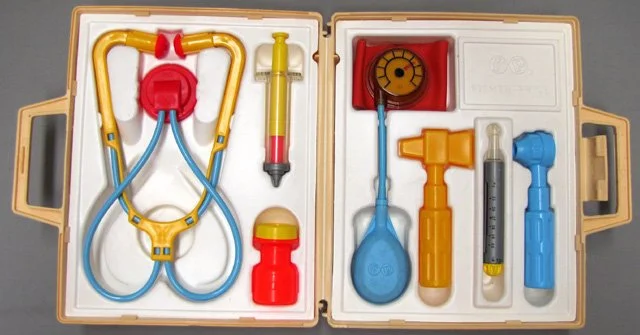
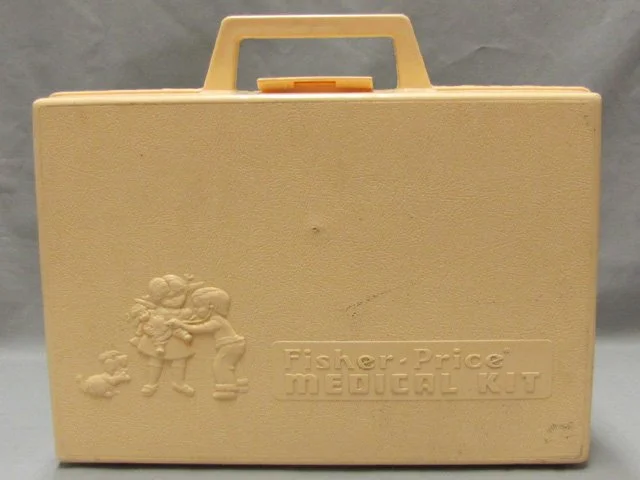
Toy Medical Instrument Kit, 1977. Museum of Health Care # 008056002 a-h.
Fisher Price’s 1977 Toy Medical Instrument Kit (Accession Number 008056002 a–h) introduced children to the clinical encounter. With its stethoscope, thermometer, and blood pressure cuff among other play tools, children pretended to listen to a heartbeat, take a temperature, or check blood pressure. Children could handle these tools and learn how they were used, becoming better equipped for their next visit with the doctor. These toys also taught children about work and gender. Historian Susan E. Lederer describes how nearly all early medical toys portrayed boys as doctors and girls as nurses—or ‘mothers’ of a stuffed animal or doll who sought medical attention.¹ In the sole image molded onto the front of the Fisher Price carrying case, a boy examines a doll, held by a girl, with a stethoscope.
Another toy medical kit in the collection (008056004 a–q) expands the world of play beyond check-ups. By the mid-twentieth century, the department of surgery was considered the heart of the hospital, and surgeons became popular celebrities.² Advances in anesthesia, antiseptic techniques, laboratory science, and medical education transformed healthcare from a profession dominated by general practitioners into one organized around distinct fields of expertise. Surgeons relied on increasingly complex instruments and technologies. Toys like this one, featuring a scalpel, microscope, and graduated cylinder, reflected these developments, introducing kids to an image of medicine grounded in scientific knowledge and technical skill.
Building Miniature Hospitals
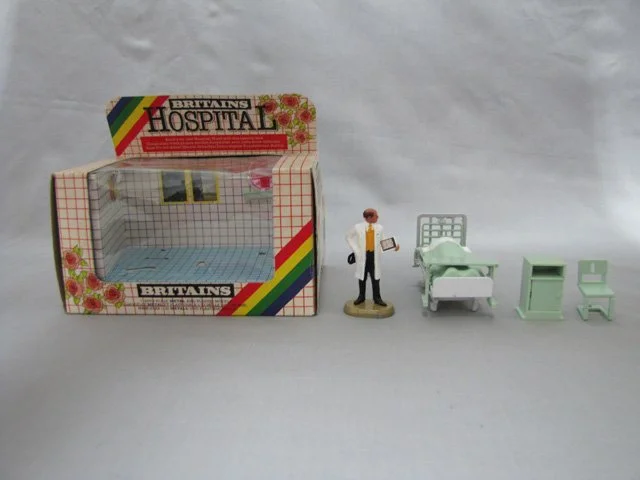
Toy Doctor and Patient, 1980. Museum of Health Care # 008056005 a-f.
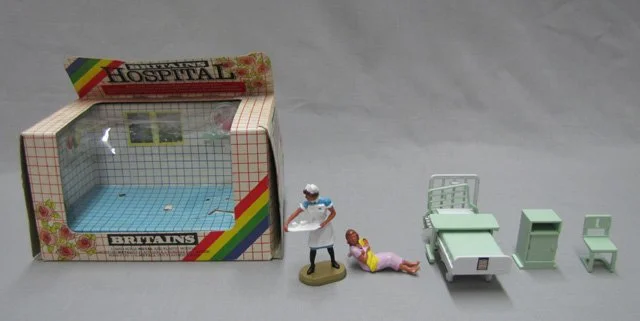
Toy Nurse with Mother and Baby, 1980. Museum of Health Care # 008056006 a-g.
Both toy medical kits came packaged in carrying cases, casting medicine as taking place ‘on the go’ as the doctor moved between spaces. Sets of toys from the brand Britain's Hospital broadened play once more to include the medical environment. The “Doctor and Patient” set (008056005 a–f) includes a male doctor figure, a patient in a hospital bed, a bedside table, and a chair. Unlike the medical kits, which focused on procedures, this toy recreated a miniature hospital room, introducing kids to hospitalization itself and the people and furniture they might encounter. A companion set, “Nurse with Mother and Baby” (008056006 a–g), introduced a new kind of person and labour: a nurse. The packaging of these sets also worked like an architectural model, letting us look into a hospital room through a ‘window’ of transparent plastic. Once opened, the box folded out to create a ward for play. These sets added a grounded spatial element to play, encouraging kids to move figurines around the space like they would with a dollhouse. They also taught kids that different kinds of care took place in different spaces, and by different people.
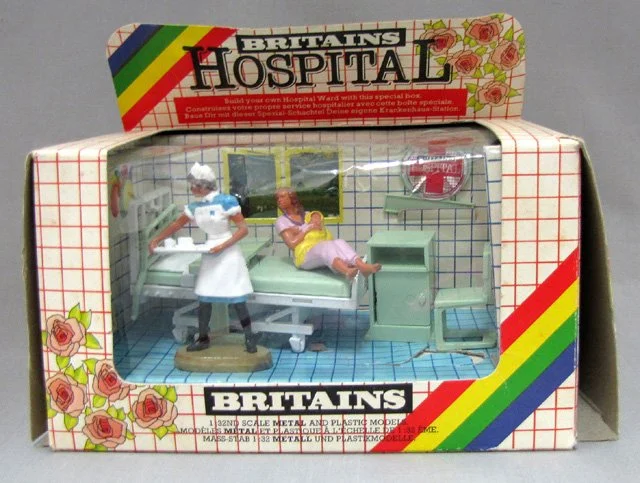
The packaging creates a vignette of the hospital room. Museum of Health Care # 008056005 a-f.
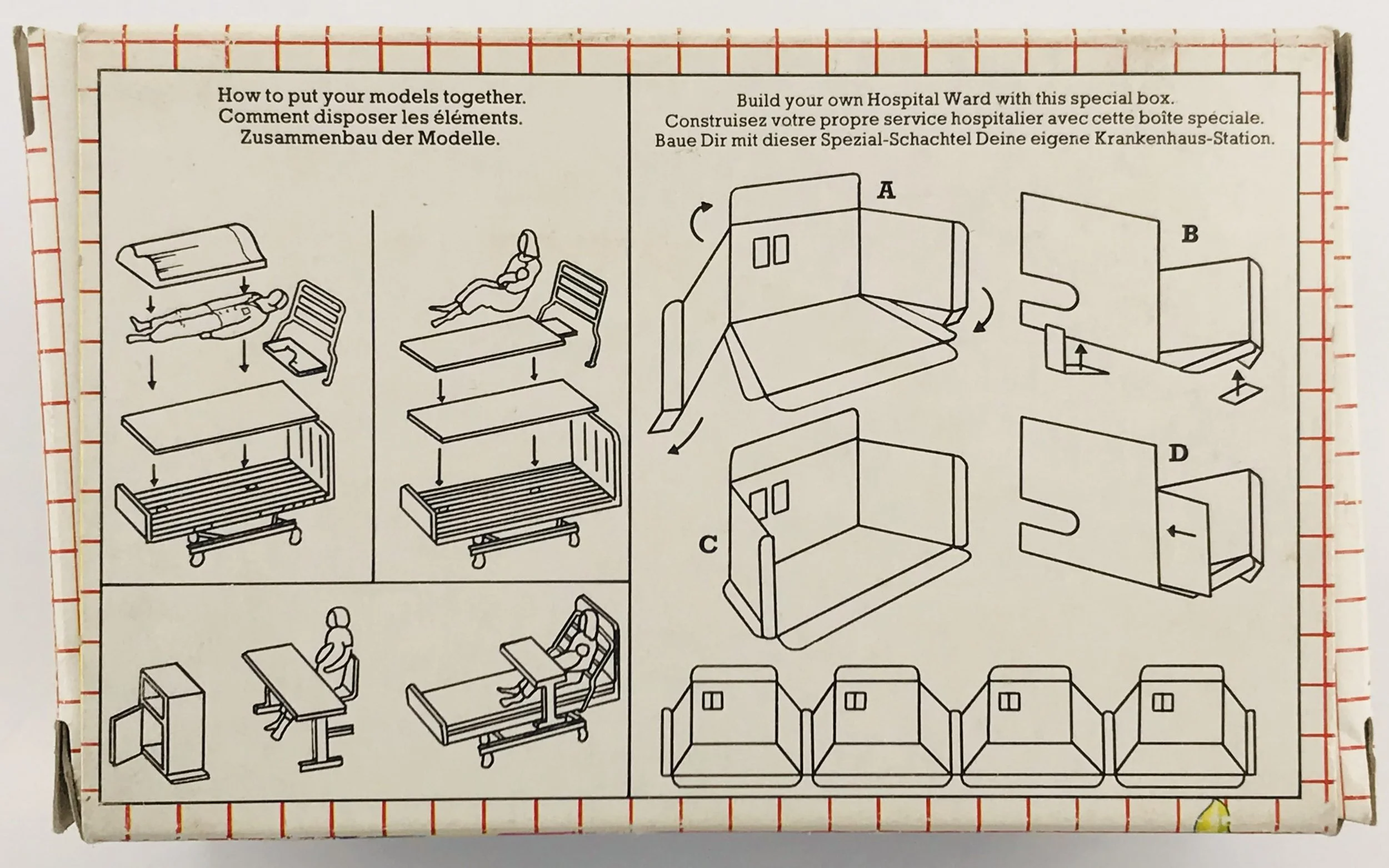
The packaging of ‘Britain’s Hospital’ toys folds out into “your own Hospital Ward.” Image: Toy Hunter UK.
Young Women and Nursing Careers
Those lessons became even more explicit in books and games aimed at teenagers and young adults. Cherry Ames, a fictional young nurse, was the star of a series of 27 novels published between 1943 and 1968. For young readers, Cherry provided an introduction to nursing as a profession and a possible future career. She cared for patients in environments like a cruise ship, a children’s hospital, and a dude ranch, and held ranks ranging from Student Nurse to Chief Nurse across the long-running series.
“It is every girl's ambition at one time or another to wear the crisp uniform of a nurse,” claims the jacket of one volume. “The many opportunities for service, for adventure, for romance, make a nurse's career a glamorous one.”³ Literary scholar Adrianne Finlay argues that Cherry Ames offered girls a carefully balanced vision of adulthood. Cherry was independent, educated, and professionally accomplished, but remained respectable, selfless, and conventionally feminine. Nursing promised adventure, travel, and career opportunities while remaining firmly rooted in ideals of service and care.⁴
This balancing act reflected broader cultural attitudes toward nursing in the mid-twentieth century. Nursing was one of the few socially acceptable professional careers available to many women, offering a degree of economic independence and specialized training.⁵ At the same time, a widespread stereotype portrayed nursing not simply as a profession in its own right, but as a pathway to marriage. Popular culture frequently suggested that nursing school was a place where young women might meet physicians and eventually leave the profession to become doctors' wives and mothers of their children. The profession therefore encouraged women to pursue education and paid work while often assuming that marriage and family would ultimately still be their primary goals.
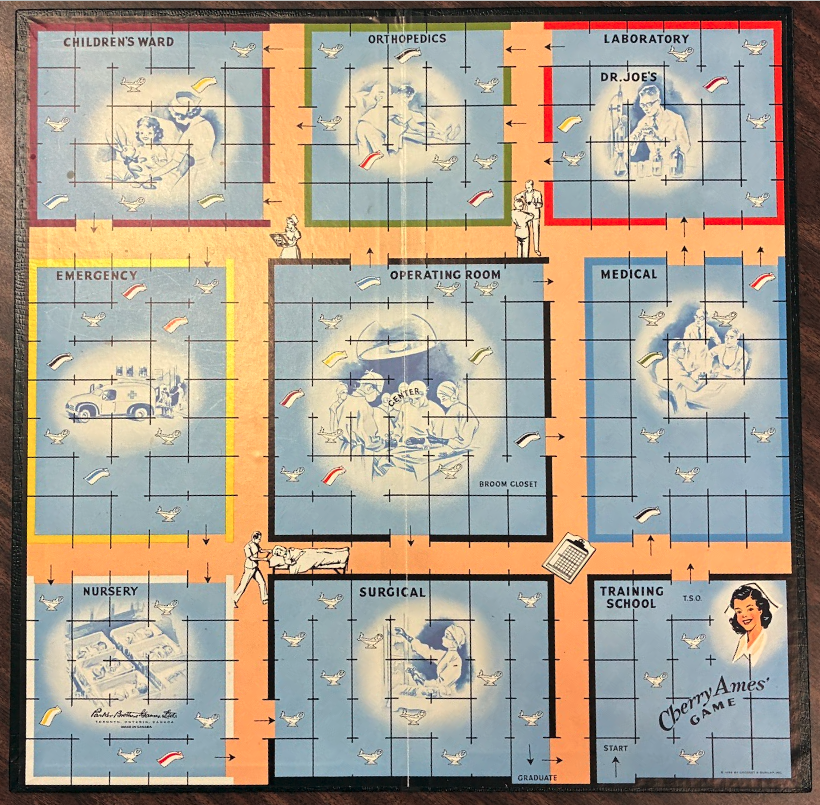
Board from the Cherry Ames Nursing Game, 1959. Museum of Health Care donation #015.013.
The books inspired a board game produced by Parker Brothers in 1959. In it, players travel around a Clue-like board through different phases of nursing training, to “win finally the treasured ‘cap’ and become a full-fledged nurse.”⁶ The values promoted by the game echoed the culture of nursing education in the decades following the reforms associated with Florence Nightingale. By the mid-twentieth century, nursing was one of the few socially acceptable professional careers available to many women, but it remained shaped by expectations of discipline, self-sacrifice, and proper conduct. Nursing students were evaluated on their technical abilities but also on their appearance, character, and adherence to professional norms. In the Cherry Ames Game, certain social activities were rewarded but others penalized: players would lose a turn for “time out for the Christmas Dance,” but move two spaces forward for having “tea with Dr. Upham.” The game's repeated references to doctors emphasized assumptions that professional success and romantic success might go hand in hand. One card instructs players to move backward after a physician tells Cherry to “wipe that rouge off [her] face,” a command given in the first Cherry Ames book, Cherry Ames, Student Nurse by Helen Wells (in the book, it turned out, the ‘rouge’ was just Cherry’s natural rosy cheeks). Professional competence, the game suggested, meant skill in addition to proper appearance and behaviour.
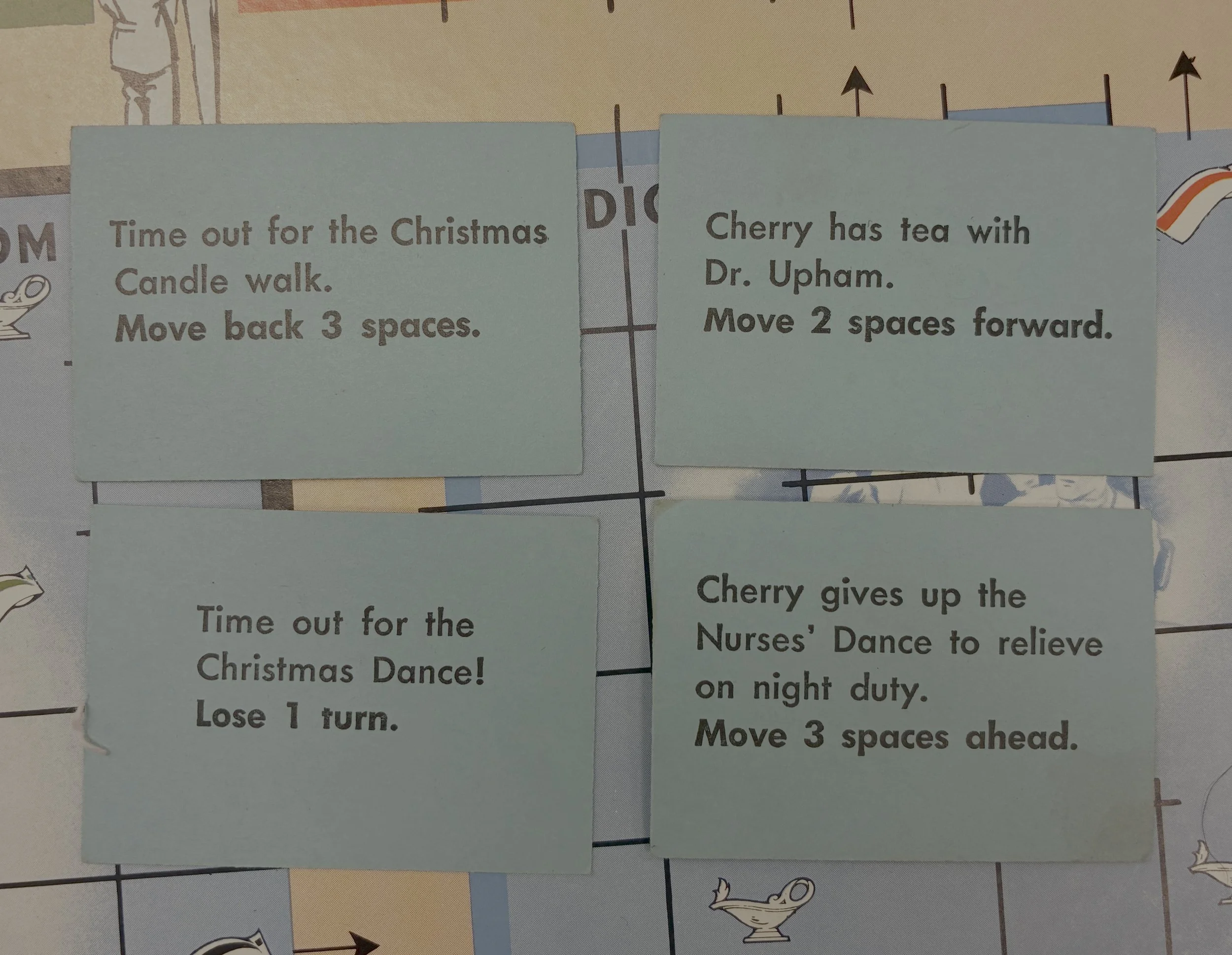
Cards from the Cherry Ames Nursing Game, 1959. Museum of Health Care donation #015.013.
The playsets and board game both entertain and teach. They helped familiarize children with medical procedures and environments, reducing fear and making unfamiliar experiences and tools easier to understand. At the same time, they communicated ideas about who worked in healthcare, how clinical encounters worked, and what roles kids could someday occupy within them. In the next blog post, I’ll look at two colouring books in the Museum’s collection and how they introduced kids specifically to new medical buildings.
Endnotes
1 Susan E. Lederer, “Playing Doctor, Playing Nurse: Perspectives on the Origins of the Toy Doctor and Nurse Kits,” Nursing History Review 25 (2017): 117-130.
2 Annmarie Adams and Thomas Schlich, “Design for Control: Surgery, Science, and Space at the Royal Victoria Hospital, Montreal, 1893-1956,” Medical History 50 (2006): 303-324; Susan E. Lederer, “Surgery and Popular Culture: Situating the Surgeon and the Surgical Experience in Popular Media,” in Thomas Schlich (ed.), The Palgrave Handbook of the History of Surgery (London: Palgrave MacMillan, 2018): 349-367.
3 Julie Campbell, Cherry Ames, Mountaineer Nurse (New York: Grosset & Dunlap, 1951).
4 Adrianne Finlay, “Cherry Ames, Disembodied Nurse: War, Sexuality, and Sacrifice in the Novels of Helen Wells,” The Journal of Popular Culture 43, no. 6 (2010): 1189-1206.
5 See for example Kathryn McPherson, Bedside Matters: The Transformation of Canadian Nursing, 1900-1990 (Toronto: University of Toronto Press, 2003) and Susan M. Reverby, Ordered to Care: The Dilemma of American Nursing, 1850-1945 (Cambridge, UK: Cambridge University Press, 1987).
6 Cherry Ames Nursing Game pamphlet, Parker Brothers (1959), Canadian Museum of Health Care (donation number 015.013).

About the Author
Fiona L. Kenney (MARF 2026)
Fiona L. Kenney is a PhD candidate at the McGill University School of Architecture interested in the intersections between architecture, care, and ethics. She holds an MDes in History and Philosophy of Design from the Harvard GSD. Her doctoral work is supported by AMS Healthcare. As the 2026 Margaret Angus Research Fellow, Fiona will examine how children’s media shaped understandings of hospital space through simplified and participatory representations of care. Centred on medical colouring books and toys, it investigates how healthcare environments were translated into legible, structured scenes that children were invited to engage with through play.
The 2026 Margaret Angus Research Fellowship was generously sponsored by Ian M. Fraser and Janine M. Schweitzer.