Black Cross Nurses
For the 30th anniversary of Black History Month, the theme is “Honouring Black Brilliance Across Generations – From Nation Builders to Tomorrow’s Visionaries.” The Canadian Museum of Health Care will be continuing our series of profiles on Black individuals’ and organizations’ contributions to healthcare by discussing the work of the Black Cross Nurses.
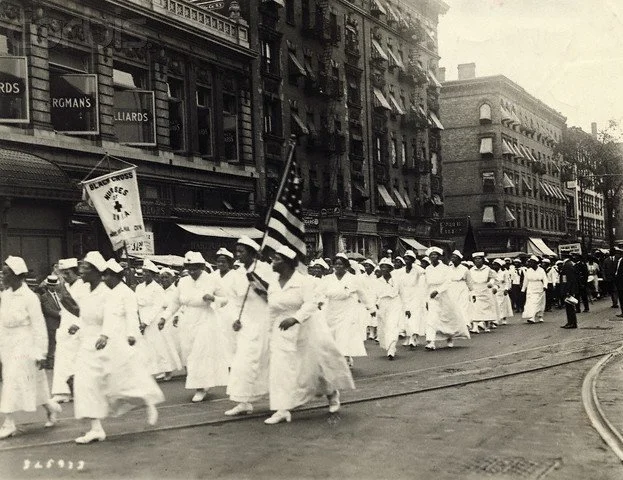
In the 19th century, very few professions were considered respectable for women to take up. Nursing was one of them, but not all women could attend nursing school. Canadian nursing schools often rejected applications from Black women, as it was believed that white patients would not want to be touched by Black nurses. In cases where Black women were permitted to train as nurses in Canada, such as in Montreal, they were only allowed to treat Black patients. For this reason, Black women who wished to become nurses often had to train in the United States.
Barriers to education did not stop Black women from providing care on health and hygiene in their communities. In May of 1920, the first chapter of the Black Cross Nurses (BCN) – modelled on the nurses of the Red Cross – was founded in Philadelphia as an auxiliary group within the Universal Negro Improvement Association and African Communities League (UNIA-ACL). The UNIA’s goal was to be a source of unification for Black communities globally and to create a united front against racial inequality. Though initially founded in Harlem, thousands of UNIA divisions were established in the Americas, Australia, and Africa. By the 1920s, Canada had 32 divisions, stretching from Nova Scotia to British Columbia. UNIA hubs provided Black Canadians with a space in which they were free to exist without having to experience the constant discrimination that permeated mainstream Canadian society.
Although the auxiliary’s international president, Isabella Lawrence of Belize, was a registered nurse, the nurses of the BCN tended to have no professional training. Lawrence enlisted the help of Henrietta Vinton Davis, who visited different UNIA branches throughout the Americas to form BCN chapters, most of which were joined by women who were already practicing nursing either formally or informally. The purpose of the BCN was to provide education and medical assistance to the Black community, and they did this through the distribution of fliers on health and public safety. BCN chapters also supported their community by caring for those who were suffering from illness (Edmonton, AB) and teaching new mothers to care for their children (Sydney, NS). The BCN’s concern for the well-being of others stretched beyond national boundaries. For instance, during the Second Italo-Abyssinian War (1936-1935), the BCN of Toronto made bandages for the Ethiopian Armed Forces.
References
https://thecanadianencyclopedia.ca/en/article/black-cross-nurses-in-canada
https://link.springer.com/content/pdf/10.1186/s12939-022-01673-w.pdf
https://www.bcnu.org/about-bcnu/human-rights-and-equity/calendar-of-observances/history-black-nurses
https://museumoftoronto.com/collection/marcus-garvey-and-the-unia/
An Efficient Womanhood, Natanya Duncan
About the Author

Thinugi Wickramasinghe
Thinugi is a 4th-year Concurrent Education student studying History and French, and plans on teaching at the high school level. She’s particularly interested in the history of the production of knowledge, but in her free time, she enjoys going for long walks at night, falling down Wikipedia rabbit holes, and embroidering. Thinugi has also previously completed an alternative practicum placement at the Museum and is delighted to be back.