By Fiona L. Kenney
In my last blog post, I looked at two colouring books in the Museum’s collection and their role in familiarizing kids to the spaces and people of the hospital. The reason for choosing an interactive form of media (a colouring book) is of interest to me: why was it important to make this learning fun? In this final post, I look at the emergence of play as a key component of children’s hospital care, and the spaces that this tool made necessary.
Play was part of hospital activity for children in the early twentieth century. By the 1920s, in some hospitals, the children’s ward did double duty, and children would play in bed or in the open areas between beds. Nurses could supervise play and provide care at the same time. Toys, books, and games came right to the bedside—as did special visitors like entertainers or celebrities.
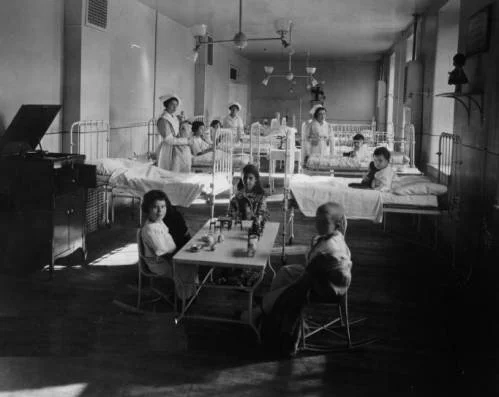
The Children's Ward at Philadelphia's old Mt. Sinai Hospital, 1920. Philadelphia Jewish Archives Photographs, Temple University Libraries.
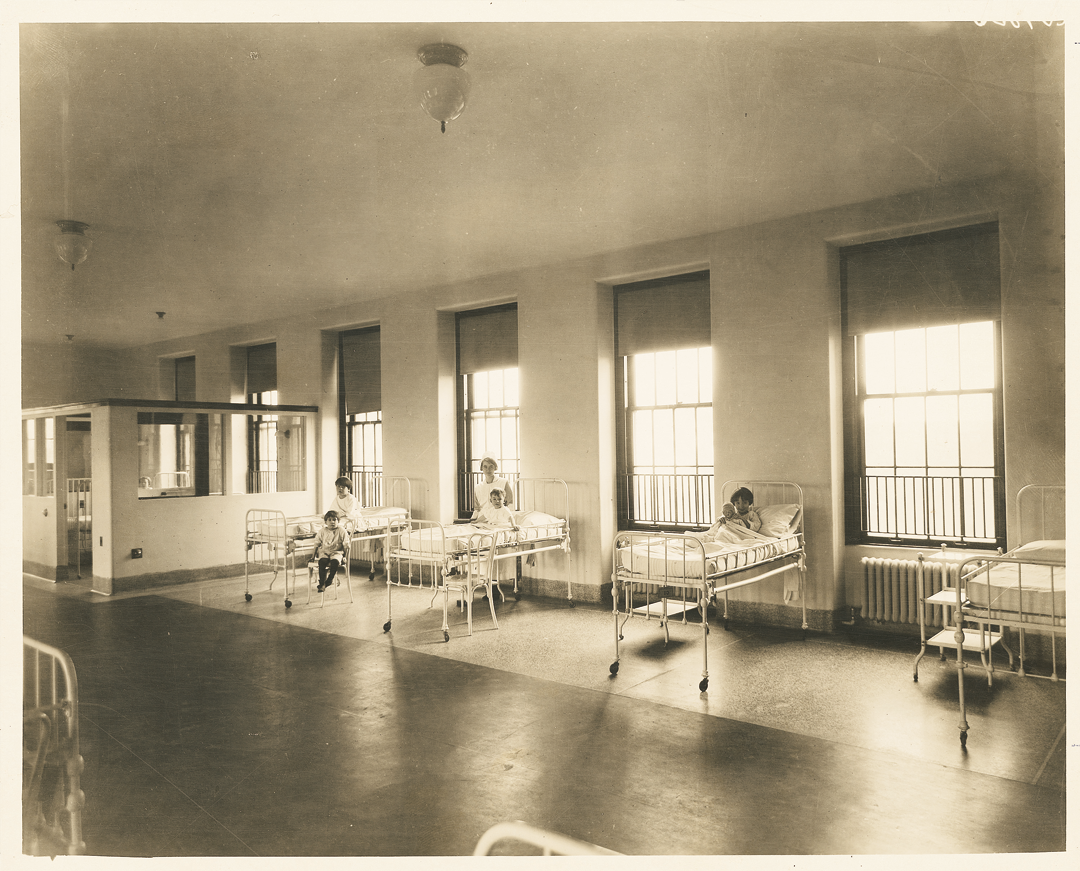
The Children’s Ward at the newly-built Butterworth Hospital, Grand Rapids, MI, 1925. Image courtesy Spectrum Health.
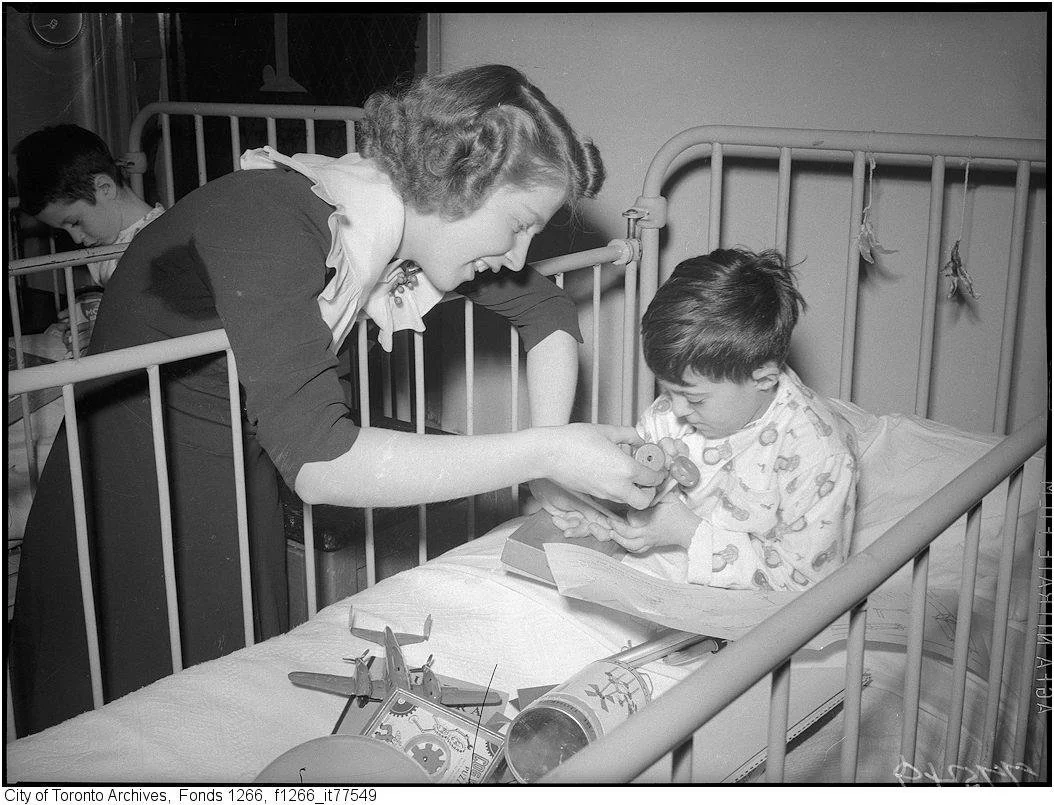
Sick Kids Hospital party, 1941, photo by John H. Boyd. City of Toronto Archives, Globe and Mail fonds, Fonds 1266, Item 77549.
One of the first documented ‘play ladies’ in the U.S., Isabelle L. Whittier began working in the children’s ward of the Massachusetts General Hospital in 1921 and had spent her first year “trying to find what two hours daily of organized play will do for sick children.”¹ She carried out her work between and beside patients’ beds, tying “soft, worsted balls, with strings of the six primary colors” to babies’ cribs and carrying older, more mobile children “pigback about the ward, touching and naming objects and talking with the other children in bed.”²
Whittier was a pioneer of a still-nascent, “undeveloped” field.³ Her aims were to “divert children of all ages” and “make children more easy for the doctors and nurses to manage,”⁴ and was still assessing which games were “too noisy” and which methods required “too much supervision to be of great use.”⁵ Her work is an early example of what would later become associated with pediatric occupational therapy. In my first blog of this series, I introduced the later program at Toronto’s Hospital for Sick Children (HSC), established in 1938. The “toy ladies” program, formally the Occupational Therapy Department, worked the same way as Whittier’s, visiting children in the wards, their “wagons piled high with games and craft work, dolls and toys.”⁶
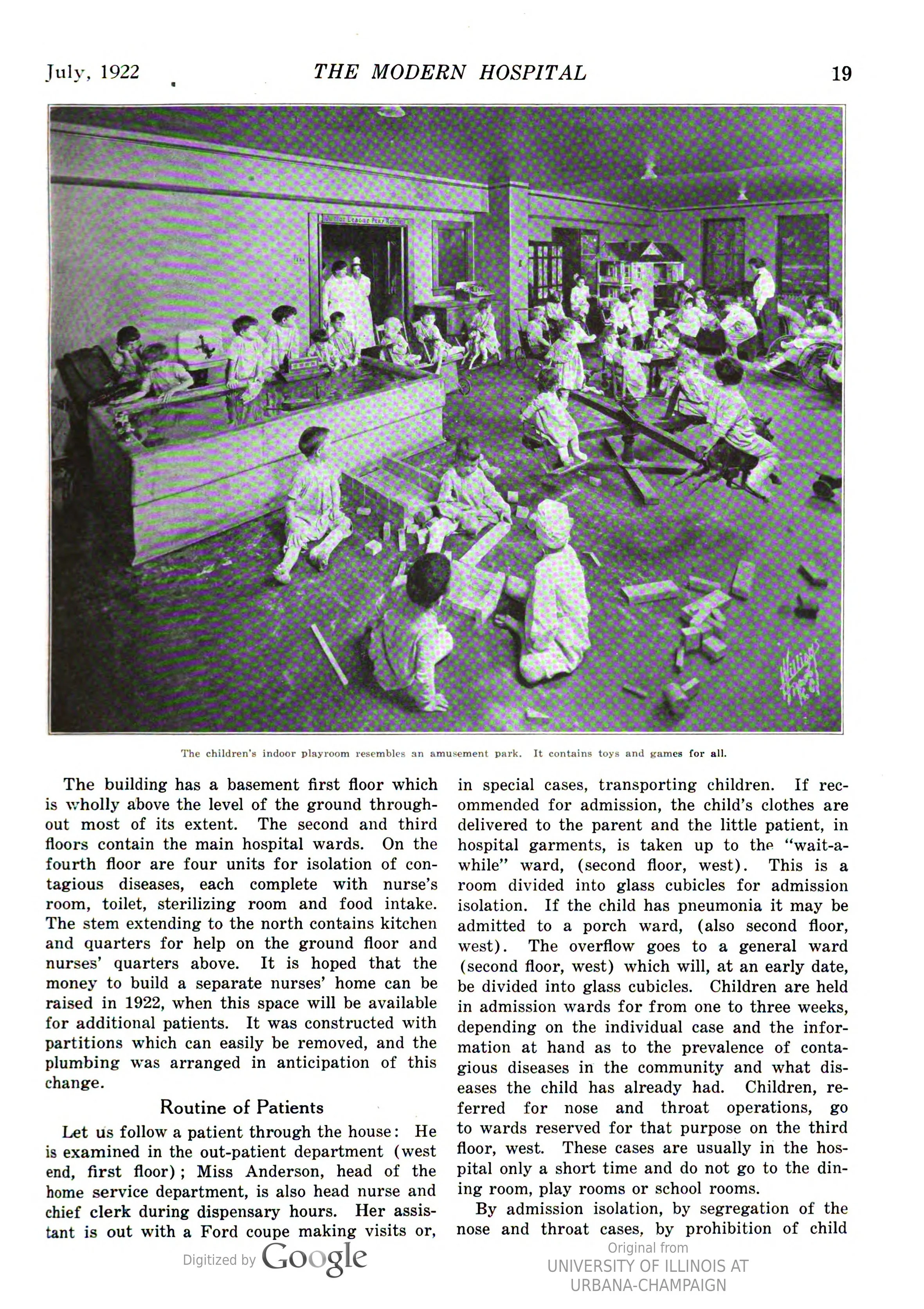
The open play room of Children’s Mercy Hospital, featured in Modern Hospital, 1922.
Other hospitals in the 1920s had more elaborate facilities for kids, like dedicated playrooms or outdoor play areas, often emulating familiar institutions like schools. The Children’s Mercy Hospital in Kansas City, Missouri, designed by architects Wight & Wight and completed in 1917, had a play room and a school room on the first floor, staffed by a full time play teacher and schoolteacher respectively, in addition to a “well equipped gymnasium and an outdoor playground.”⁷ Regardless of where play took place, its aim was to entertain the child patient and keep them grounded in their pre-hospitalization routines: “if you can keep a child contented, if he enjoys himself, keeps busy, he’s got a leg up on recovery,” said Muriel Driver, supervisor of the Toronto HSC’s OT Department.⁸
Postwar, concern grew about children’s emotional wellbeing during hospitalization (I discussed this briefly in my previous blog post). It was no longer just about keeping kids busy in hospital but about how the hospital environment affected them. Victoria Bates has shown how these concerns impacted the design of British children’s hospitals, with the dominant approach still being that “children and ‘bright colours’ went hand-in-hand.”⁹ A 1955 article in The Lancet called for hospitals to be designed with playrooms attached directly to the ward.¹⁰
Canadian hospitals began to design more explicitly for play at this time, too. London, Ontario’s War Memorial Children’s Hospital opened a "convalescent ward and play therapy room” in 1957 for children who could leave their beds but were not yet ready to return home. The room was “decorated with characters from beloved nursery rhymes” and provided a “happy atmosphere.”¹¹ Toronto’s HSC included a dedicated playroom as of 1951 when it moved to its current building, and the hospital’s Women’s Auxiliary began planning for a rooftop playground in the same year. It eventually opened in 1957 and was followed two years later by the opening of another playroom in the hospital’s outpatient waiting area.¹²
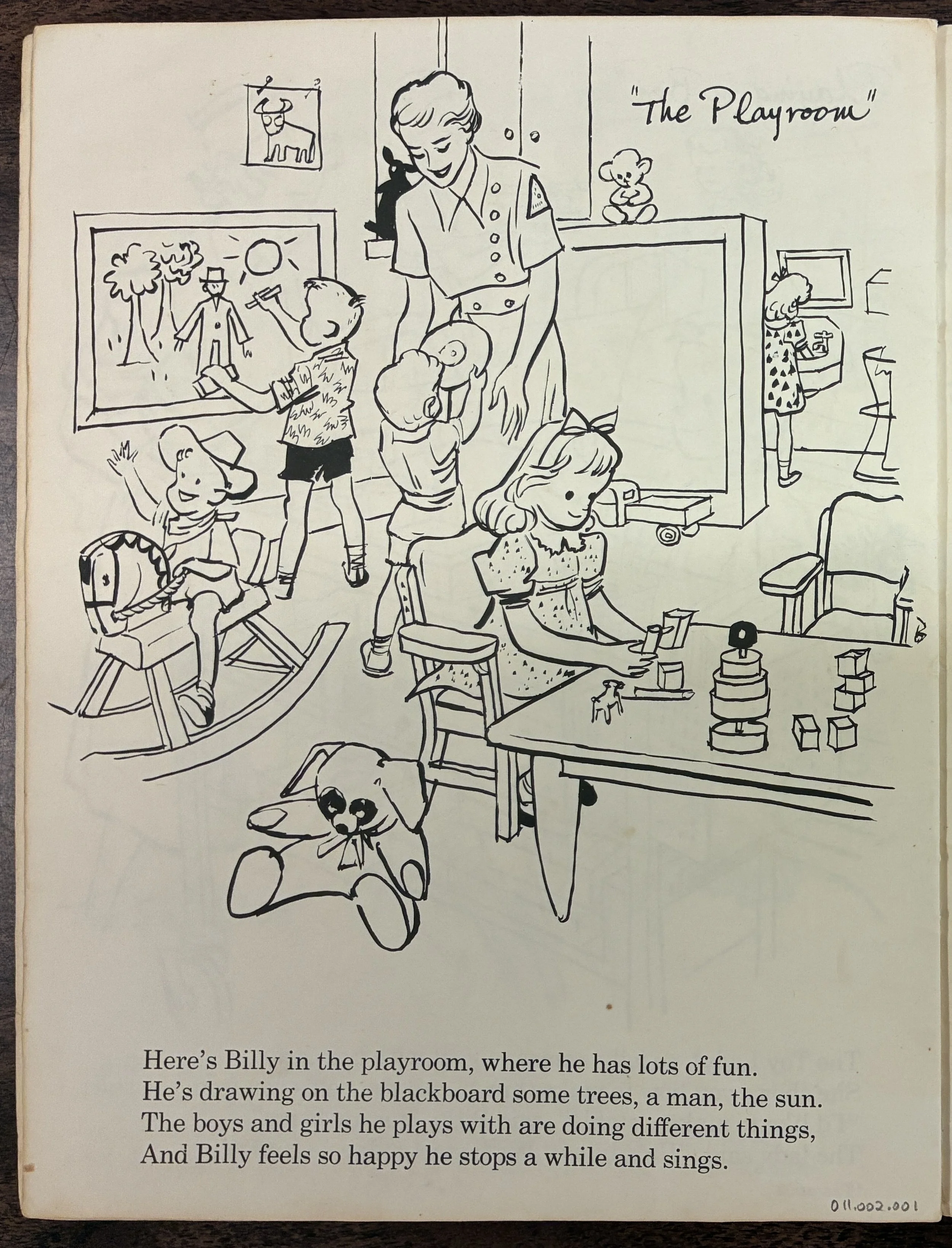
The Hospital for Sick Children’s playroom shown in Billy Goes to Hospital, c.1965. Museum of Health Care #011002001.
Play, once just an activity to help pass the time, was by the postwar period treated as something kids needed during their hospital stay. As it became a more established part of children’s hospital care, what had taken place at the bedside (or in what space was available between beds on the ward) now happened in specially designed rooms. Making room(s) for play supported and reflected a changing idea of care where kids’ experiences in the hospital were part of their treatment.
Endnotes
Isabelle L. Whittier, “Occupation for Children in Hospital Wards,” The Modern Hospital XIX, no. 1 (1922): 135.
Whittier, “Occupation for Children,” 135.
Playground and Recreation Association of America, “Children’s Play in Hospitals,” The Playground XVI, no. 1 (April 1922): 489.
Whittier, “Occupation for Children,” 135.
Playground and Recreation Association of America, “Children’s Play in Hospitals,” 489.
Jack Brehl, “‘Toy Ladies’ Bring Fun to Heal Sick Children - You Can Help Aid Work,” Toronto Daily Star, November 22, 1946, ProQuest Historical Newspapers.
Robert Schauffler, “A Charity Hospital for Children,” The Modern Hospital XIX, no. 1 (1922): 18.
Brehl, “‘Toy Ladies’ Bring Fun.”
Victoria Bates, “‘Some People Talk About Children as Though They’re Completely Different’: Hospital Art, Architecture and Design for Children in Modern Britain,” Medical Humanities 51, no. 4 (2025): 2.
R.S. Illingworth and K.S. Holt, “Children in Hospital: Some Observations on their Reactions with Special Reference to Daily Visiting,” The Lancet 266, no. 6903 (December 1955): 1257.
“War Memorial Children’s Hospital: The History and Legacy of Paediatric Care at LHSC, ” London Health Sciences Centre, n.d., https://www.lhsc.on.ca/150/moment/war-memorial-childrens-hospital-the-history-and-legacy-of-paediatric-care-at-lhsc/
David Wright, SickKids: The History of the Hospital for Sick Children (Toronto; University of Toronto Press, 2016): 215.

About the Author
Fiona L. Kenney (MARF 2026)
Fiona L. Kenney is a PhD candidate at the McGill University School of Architecture interested in the intersections between architecture, care, and ethics. She holds an MDes in History and Philosophy of Design from the Harvard GSD. Her doctoral work is supported by AMS Healthcare. As the 2026 Margaret Angus Research Fellow, Fiona will examine how children’s media shaped understandings of hospital space through simplified and participatory representations of care. Centred on medical colouring books and toys, it investigates how healthcare environments were translated into legible, structured scenes that children were invited to engage with through play.
The 2026 Margaret Angus Research Fellowship was generously sponsored by Ian M. Fraser and Janine M. Schweitzer.