Bats!: Why Canada’s Biggest Rabies Carriers are a Protected Species (Or, Why I Can’t Evict Batthew)
By: Thinugi Wickramasinghe (2026 Public Programs Assistant)
Introduction - Thinugi and the Terrible, Horrible, No Good, Very Bad Bat
Around 10pm on May 21st, 2026, I encountered Batthew for the first time. I made the foolish mistake of screaming and cowering in fear, giving Batthew – a bat – the chance to disappear into one of the house’s many nooks and crannies. He re-emerged two days later (after my landlord had done his own inspection and gave me the all-clear, mind you), and did a few laps around our living room while my roommate and I screamed at him. As if the threat of having a large winged creature randomly pop up in my house wasn’t bad enough, the creature in question could’ve also been harbouring a deadly disease. Bats are considered to be Canada’s primary rabies vectors, and it is recommended that any person who has direct contact with a bat seek post-exposure prophylaxis (PEP) to avoid a potential rabies infection. Rabies is a disease caused by the Lyssavirus rabies which attacks the central nervous system of warm-blooded animals and humans by travelling through the spinal cord to the brain, where it causes encephalitis, which is the scientific term for inflammation of the brain. Depending on the distance between rabies’ entry point on the body – which is typically a bite or scratch caused by a rabid animal – to the brain, it can take weeks to months for rabies symptoms to manifest. Once symptoms appear, the infection is almost always fatal, which is why PEP, which consists of four to five shots given out over the course of two weeks, must be administered promptly following any potential exposure.
Although I am quite certain that Batthew never made it into my bedroom, I woke up with a red mark on my arm that I didn’t remember getting. At my coworkers’ urging, I went to the emergency department at Kingston General Hospital (KGH). After a three-hour wait, I received a dose of rabies immunoglobulin, which is a blood product that contains rabies antibodies, and my first dose of the rabies vaccine. Two weeks later, I was getting my fourth and final rabies shot when my nurse told me that I should be pestering my landlord to do more to get Batthew out. Alas, dear reader, my landlord and the good people of the [redacted] pest control company had done all that they could, for bats are protected in Canada, and removing them from a home comes with several challenges, all of which are associated with bats’ protected status.
After opening a door or window to let the bat escape, the most humane way to get rid of a bat is to perform a bat exclusion, which is typically done by pest control professionals. During a bat exclusion, a one-way exit is installed near the potential entry point, ensuring that when the bat leaves to hunt bugs, it cannot get back into the building. As part of the exclusion process, all of the little cracks and crevices are sealed to prevent the bat from returning. However, because my encounter with Batthew took place at the start of the bat maternity season, there was a possibility that Batthew was actually a Batilda and that removing her from the house could result in her dependent babies dying. As I am writing this blog post, Batthew has yet to make an appearance, but I am still not entirely confident that Batthew and I will never meet again. This predicament led me to the question that forms the basis of this blog post: if the risk of bats passing on rabies to humans is so significant, why are they so protected?
The Lore on Rabies I - Its History and Symptoms
Rabies has been on the historical record since the 23rd century BCE. The Laws of Eshnunna from Ancient Babylon mentions dog owners being fined for deaths caused by their dogs biting people and giving them rabies. Several authors from classical antiquity referenced rabies in their writings. For example, Galen (129-216 CE), took note of the absence of symptoms in bite victims before the onset of rabies. Later physicians, such as Dioscorides and Philomenos, recorded their observations that the disease’s latency period ranged from six weeks to years following contact with a rabid animal.
Today, rabies impacts people and animals on all continents of the globe (except Antarctica), with more than 95% of human deaths occurring in Asia and Africa. Because its incubation period is so long – ranging on average from two weeks to six months or even longer – diagnosing rabies before symptoms have manifested can be extremely difficult, and at that point, the infection will have progressed enough to be fatal. Early rabies symptoms, such as headaches, anxiety, restlessness, fever, and pain at the site of an animal bite could all be attributed to other, less deadly illnesses. As the rabies virus continues to spread through the central nervous system, the disease will begin to manifest in its furious or dumb form. In its furious form – which is the most common form that affects humans – rabies can cause people and animals to exhibit aggressive behaviour, experience hallucinations, seizures, muscle twitching, hyperventilation, and an increased heart rate. One of the most obvious signs of furious rabies is violent spasming in the throat, which can make swallowing water and other liquids difficult. Because of this spasming, rabies in humans is sometimes referred to as “hydrophobia” because the intense spasms can cause people to develop an intense fear of water. In its dumb form, also known as paralytic rabies, the victim experiences a progressive form of paralysis. In both forms, rabies symptoms will typically progress towards full paralysis and coma before culminating in the death of the victim.
The Lore on Rabies II - The Evolution of Treatments
By the time it becomes clear that a person has rabies, it is typically too late to save them. This is why the doctors at KGH (and healthcare professionals more broadly) emphasise preventing contact with bats and other wild animals. Much like today’s public health officials, ancient sources emphasise taking measures to prevent the spread of rabies. For instance, Columna’s De Re Rustica (circa 60 CE) described shepherds’ habit of cutting their dogs’ tails as puppies as a preventative measure against rabies in case they were bitten. Throughout the Early Modern period, several European cities took steps to restrict the movements of all dogs – domestic and stray – with some outright eliminating the latter. These measures proved to be greatly successful for the control of the disease, as canine rabies was virtually eliminated from Denmark, Sweden, and Norway by 1826. Despite this progress, treatments for preventing rabies following exposure to rabid animals hardly advanced. Research into potential vaccines for rabies was spearheaded by Louis Pasteur in 1880, who at this point in his career already had quite a few groundbreaking discoveries under his belt. The experiments that led to the creation of his rabies vaccine involved intentionally infecting stray dogs with the disease, and giving them extracts from the dried spinal cords of rabid rabbits, which showed promising results.
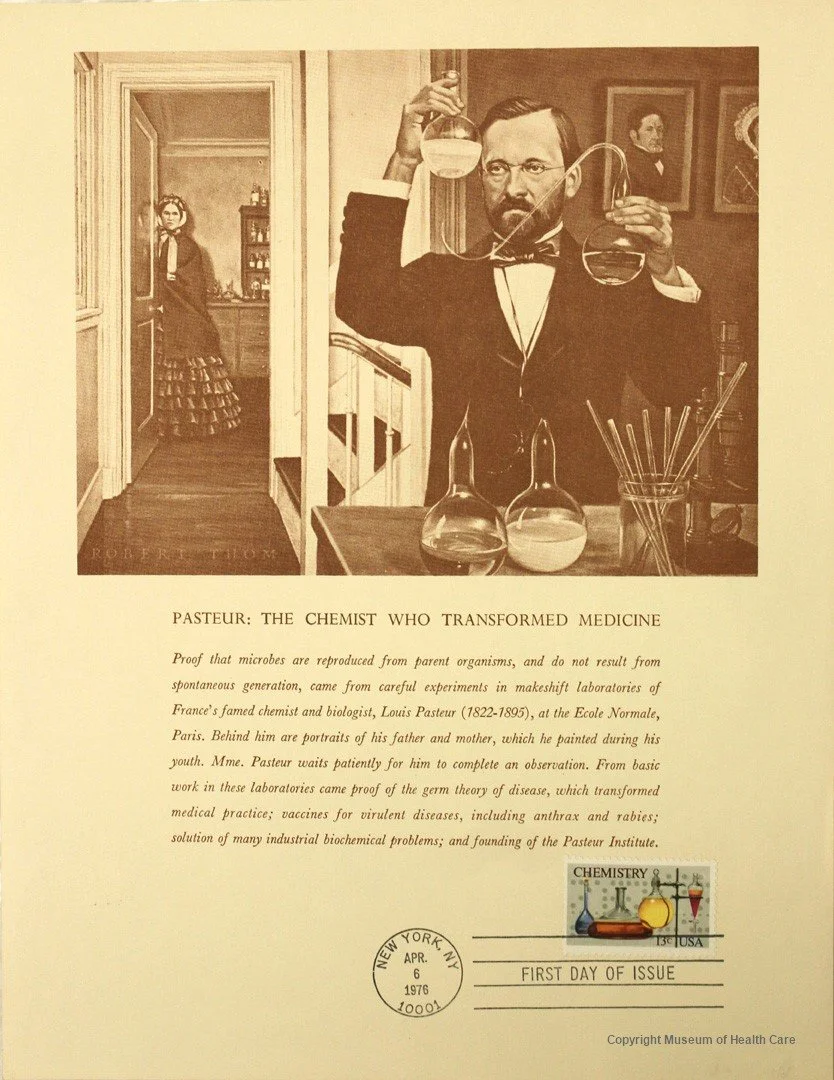
Figure 1: Postage stamp commemorating Louis Pasteur’s contributions to modern medicine, such as the rabies and anthrax vaccines
In July of 1885, while the post-exposure rabies vaccine was still in development, Pasteur was approached by Marie-Angélique Meister, whose son, Joseph, had been bitten fourteen times by a rabid dog. Knowing that time was of the essence, she begged Pasteur to save her son. Pasteur was hesitant; while he had seen positive results when testing on animals, he had never administered the vaccine on a human. Moreover, Pasteur was a chemist, and therefore was not licensed to treat humans. Because of this, a paediatrician associated with Pasteur’s lab performed the vaccination so that if anything went wrong, Pasteur could not be accused of wrongdoing. Luckily for everyone involved, Meister never exhibited any of the clinical signs of rabies, meaning that the PEP shot had done its job. Today, the rabies vaccine can be made using both human and animal cells, while the immunoglobulin is a human blood product that contains rabies antibodies which can provide more immediate protection until the body can produce its own.
A pre-exposure rabies vaccine does exist, but it is not covered under provincial health insurance (at least in Ontario), and can cost hundreds of dollars due to its complicated manufacturing process and a limited demand. Due to limited availability, rabies pre- and post-exposure vaccines have remained one of the most expensive forms of medical treatment since Pasteur first developed his original vaccine during the 19th century. In 1952, Connaught Medical Research Laboratories, which produced vaccines and antitoxins which were commonly prescribed by Canadian physicians, charged $20.35 for the rabies vaccine ($243.91 today). For comparison, all of the other vaccines listed by Connaught range between 60 cents and $17.55, making the rabies vaccine the most costly, and likely out of reach to most Canadians.

Figure 2: A List of Current Prices to the Medical Profession January 1952 [price list]. The rabies vaccine is listed on the eighth row from the left on the first page.
Rabies in Canada: An Overview
Different regions of the world have different primary rabies vectors. In Asia and Africa, dogs are the most common spreaders of the disease. Although much of the European Union is considered free of terrestrial rabies, bats have recently begun to rise to prominence as carriers of the illness. For many years, rabies transmission to humans via bats was thought to only occur in the Americas, in addition to other terrestrial wildlife like foxes and raccoons. In Canada, bats continue to dominate as the main spreaders of rabies in humans, as they have been responsible for all human rabies cases since 1967. Biological and behavioural factors contribute to Canadian bats’ susceptibility to contracting and transmitting the disease. All Canadian bats are insectivorous, and rabies’ incubation period in insectivorous bats can be quite long, which can result in a higher viral load in their saliva. Moreover, some bats can shed the virus in their saliva for 12 to 15 days before exhibiting clinical symptoms. Bats can even develop immunity to rabies if their mothers are able to transfer rabies antibodies in utero to help them fight the disease. On the behavioural side, bats roost in groups, and rabid bats will often act aggressively and bite other bats in their social group, thus passing on the virus.
Between 1924 and June 2026, only 28 human rabies cases have been reported in Canada. At the federal level, Health Canada is responsible for surveilling the disease, developing guidelines for administering pre- and post-exposure prophylaxis, and supporting provincial and territorial ministries in their management of the disease. All rabies cases in animals must be reported to the Canadian Food Inspection Agency, which is responsible for testing potentially rabid animals and sharing the results with the public. In order to definitively determine that an animal has rabies, specific parts of the brain must be examined, and this can take place only after the animal has died. Because bats are protected in Canada, this means that only bats that have had direct contact with humans or have been exhibiting concerning behaviour (such as being active during the day) can legally be killed and submitted for testing. In 2024, only 49 bats in Ontario tested positive for rabies, but this number could be higher due to restrictions on rabies testing. While the numbers are promising, these statistics are not an indication that human rabies is a disease of a bygone era. As recently as 2024, a young boy died of a rabies infection after waking up to a bat on his face. As the family did not believe that the bat was acting strangely, they did not seek medical attention until the boy began to show clinical signs of rabies. He passed away after only 17 days in the hospital.
Of Bugs and Bees: Bats’ Saving Grace
Every creature indigenous to Canada has a role to play in its ecosystem. Despite their reputations for being scary and harbouring diseases, bats are an essential part of the Canadian food system as controllers of pests and proponents of pollination. On the pest control side, Canadian bats can eat hundreds of insects such as moths, beetles, and mosquitos in a single hour. Their huge appetite for bugs greatly reduces the need for chemical pesticides to protect crops, which not only helps farmers save money, but ensures adequate crop yields while reducing pollution.
Pesticide use is problematic for a number of reasons. Firstly, they not only kill off crop-destroying pests, but the pollinators that ensure their steady growth, such as honeybees. Secondly, the chemicals from pesticides can also contaminate local waterways, leading to excessive algae growth that can decimate aquatic life. Finally, pesticides can have the unintended consequence of targeting crop-destroying pests’ natural predators, such as ladybugs, which can prompt farmers to use them even more.
Avoiding pesticides also has positive benefits for human health. The Canadian Centre for Occupational Health and Safety (CCOHS) claims that people exposed to pesticides on a regular basis, such as agricultural workers, are at an increased risk of long-term health effects, such as developing different forms of cancer. According to CCOHS, exposure to pesticides by ingestion is less common than exposure by inhalation or through the skin, meaning that the average person is unlikely to experience pesticide poisoning from produce.
Conclusion: Maintaining the Balance
Two things can be true at once: bats are Canada’s primary rabies carriers and they do play an essential role in Canada’s various ecosystems. Really, the only argument in favour of protecting bats is their role in controlling Canada’s insect populations and reducing reliance on pesticides. To that end, scientists are using bats’ natural predatory instincts to their advantage. In 2026, a group of Chinese researchers published a study on their use of mosquitos as rabies vaccines for bats. They fed the mosquitos blood laced with a rabies vaccine and then exposed wild bats to them. The bats either ate the mosquitos or were bitten by them; either way, when samples of their blood were taken for testing, the scientists were amazed to find that the bats had developed their own rabies antibodies. The same team also developed a saline solution laced with the rabies vaccine that the bats seemed happy to drink, leading to high hopes that bat rabies, like canine rabies, can become much more controllable. Still, like most scientific discoveries in the field of medicine, it might take a while for us to see this science put to use globally. Until then, I’ll be waiting for Batthew to reappear.
Bibliography
Primary sources (items from the CMHC collection)
A List of Current Prices to the Medical Profession January 1952 [product catalogue, #006030032]. Includes a rabies vaccine.
Pasteur: The Chemist Who Transformed Medicine [commemorative postage stamp, #1979.19.4]
Articles and monographs
“Bats in Buildings: A Guide to Safe and Humane Exclusions,” Ontario Ministry of Natural Resources, June 19, 2013, https://files.ontario.ca/environment-and-energy/species-at-risk/mnr_sar_tx_bat_exclu_enfr.pdf.
Beltz, Lisa A. “RABIES VIRUS AND OTHER BAT RHABDOVIRUSES.” In Bats and Human Health: Ebola, SARS, Rabies and Beyond. John Wiley & Sons, Inc, 2017. https://doi.org/10.1002/9781119150060.ch2.
Brogren, Carl-Henrik. “Louis Pasteur: The life of a controversial scientist with a prepared mind, driven by curiosity, motivation, and competition.” Journal of Pathology, Microbiology and Immunology 132, no. 1 (2023). https://onlinelibrary-wiley-com.proxy.queensu.ca/doi/full/10.1111/apm.13325.
Davis, Wynne. “The Capitol fox fascinated folks. But no one mentioned the cost of rabies treatment,” National Public Radio, April 2, 2022. https://www.npr.org/2022/04/09/1091797594/the-capitol-fox-fascinated-folks-but-no-one-mentioned-the-cost-of-rabies-treatme.
Daniel, Ari., “Vaccinating bats could be good for people. But how do you vaccinate a bat?” National Public Radio, March 13, 2026, https://www.npr.org/2026/03/13/g-s1-113183/vaccinate-vaccine-bats-rabies-nipah.
Garg, Sudhi Ranjan. Rabies in Man and Animals. 1st ed. 2014. Springer India, 2014. https://doi.org/10.1007/978-81-322-1605-6.
Gregory, David John. Taking the Bite out of Rabies : The Evolution of Rabies Management in Canada. Edited by David J. Gregory and Rowland R. Tinline. University of Toronto Press, 2020. https://doi.org/10.3138/9781487519827.
“History of the First Rabies Vaccination.” Institut Pasteur. 15 November 2023. https://www.pasteur.fr/en/research-journal/news/history-first-rabies-vaccination-1885.
Hongyue Li et al, “Ecological vaccination: A strategy to prevent zoonotic spillover from bats.” Science Advances 12, no. 11 (2026). https://www.science.org/doi/10.1126/sciadv.aec0269.
Jackson, Alan C. “Demise of the Milwaukee Protocol for Rabies,” Clinical Infectious Diseases 81, no. 4 (2025), https://pubmed.ncbi.nlm.nih.gov/40139921/
Klein, Robyn S. “Rabies.” Merck Manual. July 2026. https://www.merckmanuals.com/professional/neurologic-disorders/brain-infections/rabies.
Making life better for bats and people in Canada,” Parks Canada, March 7, 2025, https://parks.canada.ca/nature/science/especes-species/chauve-souris-canada-bats.
“Neocotinoid insecticides,” Government of Canada, 29 April, 2026, https://www.canada.ca/en/health-canada/services/consumer-product-safety/pesticides-pest-management/growers-commercial-users/neonicotinoid-insecticides.html.
“Pesticides,” Canadian Centre for Occupational Health and Safety, August 28, 2025, https://www.ccohs.ca/oshanswers/chemicals/pesticides/health_effects.html#section-1-hdr.
“Rabies in humans,” Government of Ontario, May 29, 2026. https://www.ontario.ca/page/rabies-humans.
“Rabies: The Disease and Vaccines.” Children’s Hospital of Philadelphia. https://www.chop.edu/vaccine-education-center/vaccine-details/rabies-vaccine.
“Rabies in Canada,” Government of Canada, May 2, 2026, https://inspection.canada.ca/en/animal-health/terrestrial-animals/diseases/reportable/rabies/canada.
“Rabies vaccines: Canadian Immunization Guide,” Government of Canada. April 16, 2026. https://www.canada.ca/en/public-health/services/publications/healthy-living/canadian-immunization-guide-part-4-active-vaccines/page-18-rabies-vaccine.html.
Reinhardt, Fabian, Sebastian Wendt, Martin Pfeffer, Conrad Freuling, Thomas Müller, and Christoph Lübbert. “Rabies in Europe: Epidemiology, Clinical Management, and Prevention.” Deutsches Ärzteblatt International (Germany) 123, no. 4 (2026): 108–14. https://doi.org/10.3238/arztebl.m2025.0220.
Reuven Yaron, The Laws of Eshnunna (The Magnus Press, 1988), 79, https://mc.dlib.nyu.edu/files/books/brill_awdl000033/brill_awdl000033_lo.pdf.
Tarantola, Arnaud. “Four Thousand Years of Concepts Relating to Rabies in Animals and Humans, Its Prevention and Its Cure.” Tropical Medicine and Infectious Disease (Switzerland) 2, no. 2 (2017): 5. https://doi.org/10.3390/tropicalmed2020005. \
Zafar, Amina. “What you need to know about rabies in Canada,” Canadian Broadcasting Corporation, 19 July, 2019, https://www.cbc.ca/news/health/rabies-what-you-need-to-know-1.5213739.